
How to Read an Aircraft Chemical Safety Data Sheet

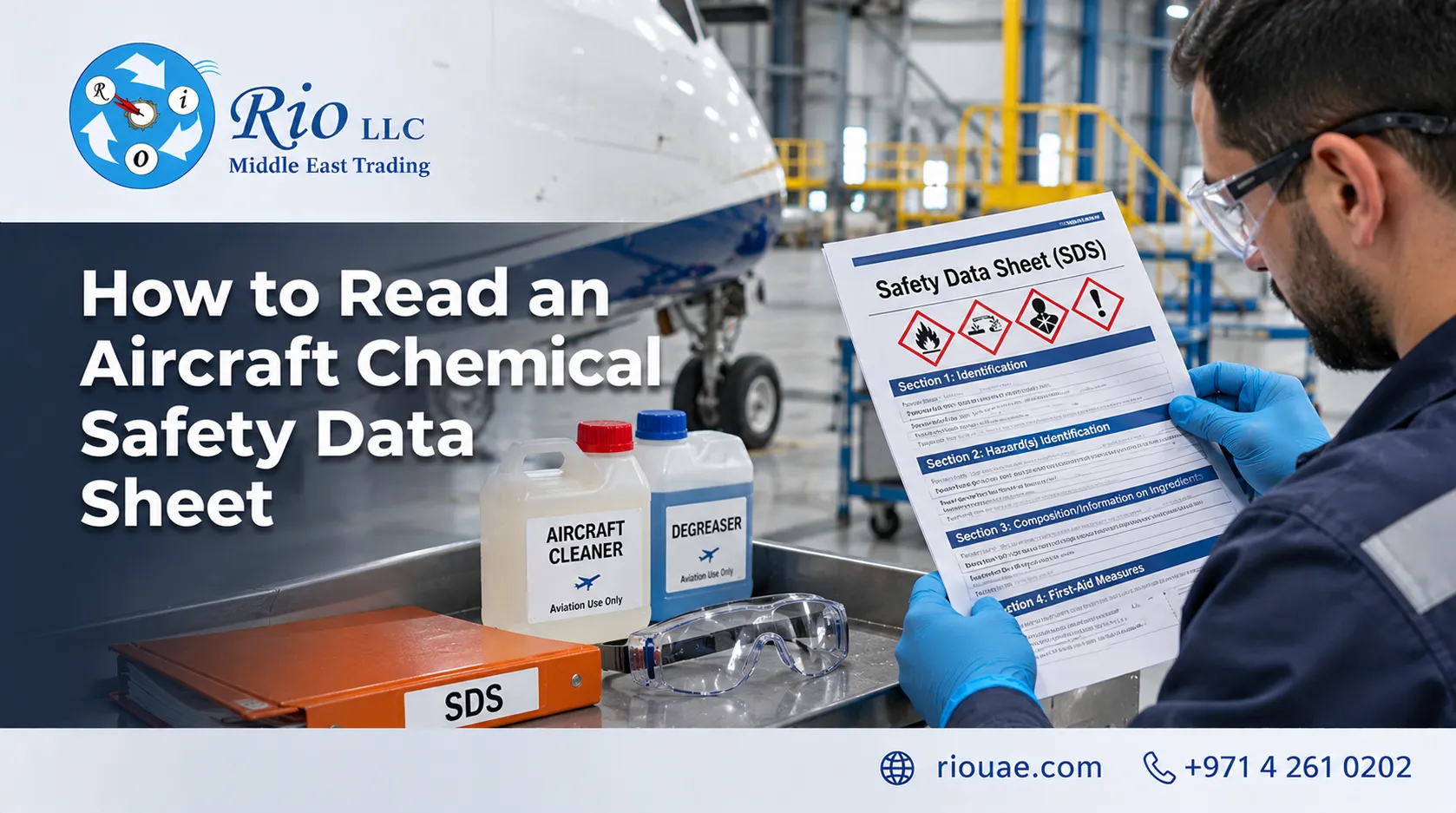
A container arrives at an aircraft maintenance facility with a familiar product name and a safety document attached. The paperwork looks complete, but several questions remain: does the document match this formulation, what precautions matter for the planned task, and where can the team confirm aircraft compatibility?
An aircraft chemical safety data sheet helps answer the hazard and handling questions. It provides information used to understand a chemical product’s hazards, exposure controls, storage needs, and emergency measures. It does not independently establish that the product is suitable for a particular aircraft application.
Reading the document well means connecting its sections to decisions. This guide explains how to navigate an aviation chemical SDS, distinguish it from technical and quality records, and recognize gaps that need clarification before work begins.
What Is an Aircraft Chemical Safety Data Sheet?
The phrase describes the Safety Data Sheet associated with a chemical used in an aircraft maintenance or manufacturing environment. It is not a separate universal aviation approval document. SDS principles apply across chemical products; the aviation context makes correct identification and connection to the maintenance task especially important.
An SDS usually follows a familiar sixteen-section structure, although legal requirements and document details depend on the jurisdiction. Region, language, supplier information, and formulation can all affect which version is appropriate.
For the wider maintenance context, RIO’s guide to aerospace maintenance chemicals explains the different functions these products serve. This article focuses on understanding their documentation rather than choosing a chemical category.
SDS, TDS, and Quality Records: Different Questions
Useful aerospace product documentation connects several kinds of evidence. Each document answers a different question.
| Document | Main question it helps answer |
| Safety Data Sheet, or SDS | What hazards and handling precautions are associated with this product? |
| Technical Data Sheet, or TDS | What characteristics, intended applications, and processing information does the manufacturer provide? |
| Certificate of Conformity | What conformity statement is supplied for the identified material or shipment? |
| Certificate of Analysis, where supplied | What reported test results relate to the identified batch? |
| Applicable maintenance or process instructions | Which product and method are permitted for this aircraft task? |
An aircraft chemical technical data sheet may describe application conditions, mixing information, or typical performance. Those details do not replace the hazard information in the SDS.
Likewise, an SDS is not a batch acceptance certificate. Finding the correct safety document is one part of building a complete and relevant document set.
A Quick Map of the Sixteen SDS Sections
The following map helps readers locate information in the common SDS layout. Exact wording and required content can vary with the applicable framework.
| Section | Topic | Reading purpose |
| 1 | Identification | Match the product and supplier |
| 2 | Hazard identification | Understand the hazard summary |
| 3 | Composition and ingredients | Review disclosed chemical constituents |
| 4 | First-aid measures | Locate exposure response information |
| 5 | Fire-fighting measures | Identify fire-related information |
| 6 | Accidental release measures | Review spill precautions |
| 7 | Handling and storage | Understand routine precautions |
| 8 | Exposure controls and personal protection | Review exposure limits and controls |
| 9 | Physical and chemical properties | Understand relevant product properties |
| 10 | Stability and reactivity | Identify incompatibilities and conditions to avoid |
| 11 | Toxicological information | Review health effects and exposure routes |
| 12 | Ecological information | Understand environmental information |
| 13 | Disposal considerations | Identify waste-related guidance |
| 14 | Transport information | Review transport classification information |
| 15 | Regulatory information | Identify jurisdiction-specific references |
| 16 | Other information | Check revision and explanatory details |
OSHA’s SDS Appendix D provides an official reference for the US framework. It is useful for understanding the format; a UAE operation must also address its applicable local requirements. Occupational Safety and Health Administration
Aircraft Chemical Safety Data Sheet: A Practical Reading Order
1. Confirm the product before interpreting its hazards
Start with Section 1 and compare its identifier with the container label. Check the manufacturer or supplier, exact name, and available product references. Similar branding does not guarantee the same composition.
A liquid, aerosol, coloured variant, or separate kit component may require different documentation. Do not select a PDF solely because its filename contains the familiar product family name.
Section 1 can also describe recommended uses, restrictions, and emergency contact information. Confirm that contact details are relevant and usable for the receiving location.
Keep batch identification in the appropriate traceability records. An SDS commonly covers a product formulation across multiple batches, so it should not be expected to serve as the shipment’s batch certificate.
2. Read the hazard summary as a set
Section 2 brings together classification information, signal words, hazard statements, and precautionary statements. Read these elements together rather than judging the product from a single pictogram.
For example, a reader who notices only a flammability warning could overlook a separate health hazard. The purpose is to understand the range of hazards identified for the product and then connect them to the planned activity.
Section 11 adds information about exposure routes, symptoms, and health effects. Terms such as irritation and sensitisation describe different concerns; they should not be treated as interchangeable labels.
An aviation chemical SDS should prompt specific questions about the task: could material reach the skin, eyes, or breathing zone, and which controls address those routes?
3. Understand what the ingredient list can tell you
Section 3 identifies ingredients disclosed under the applicable rules, often with chemical names, identifying numbers, and concentrations or ranges.
A CAS number identifies a chemical substance; it does not identify the commercial product as a whole. Two formulations can share an ingredient while having different overall hazards and intended applications.
The ingredient list is also not necessarily the manufacturer’s complete recipe. Disclosure thresholds and permitted confidentiality provisions can affect what appears.
Use this section to clarify chemical identity and support competent safety review. It should not be used to reverse-engineer a product or justify substituting another chemical with a similar ingredient list.
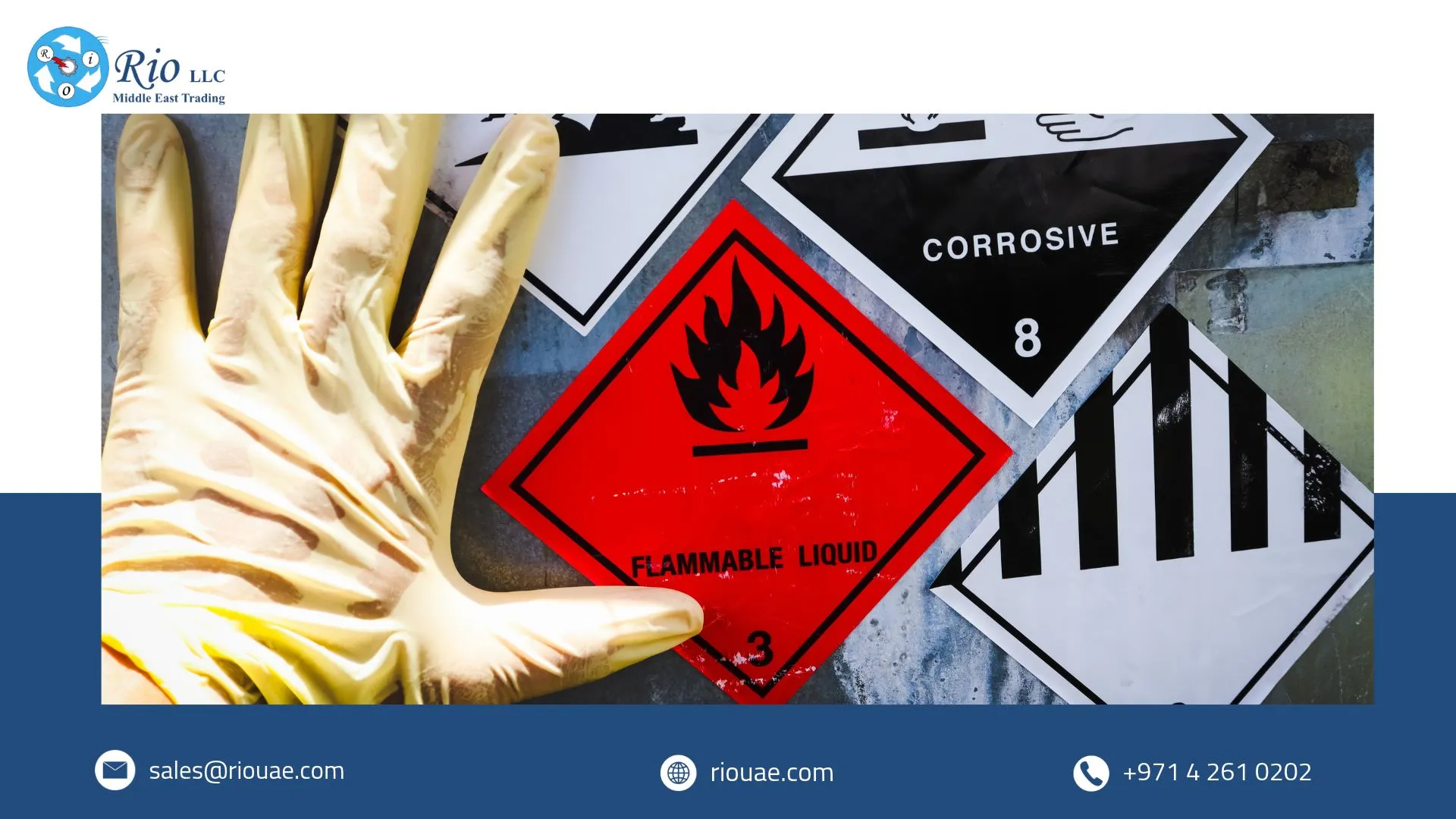
Connect Storage Instructions with Reactivity Information
Sections 7 and 10 belong together when planning storage and handling. Section 7 addresses routine precautions, while Section 10 identifies stability concerns, incompatible materials, and conditions to avoid.
Read these against the actual storage arrangement. A cabinet containing several products needs more consideration than a check that each container fits on the shelf. Shared storage decisions should account for the incompatibilities identified in the relevant documents.
Section 9 supplies supporting properties, such as physical state and flash point where applicable. A flash point is not a universal safe working temperature, and it should not be confused with auto-ignition temperature.
RIO’s surface preparation category includes products performing different functions. Sharing a catalogue category does not establish that products can be stored together, mixed, or used with identical precautions.
Read Exposure Controls Beyond the PPE Line
Section 8 may include occupational exposure limits, engineering controls, and personal protective equipment information. These are inputs to the workplace assessment, not a complete task-specific operating plan.
A brief wiping task, extended handling, and spray application can create different exposure conditions. The assessment needs to consider the method, duration, quantity, and work environment.
Glove selection requires more than choosing a familiar material name. Chemical compatibility, glove construction, permeation data, degradation, and the expected contact conditions matter. Manufacturer performance data can help the responsible safety professional assess suitability.
Similarly, wording about respiratory protection does not justify choosing a generic mask. Any required respiratory protection needs competent selection within the relevant workplace programme.
Well-managed aerospace chemical handling documents connect the supplier’s recommendations with the controls actually provided at the workstation. A downloaded SDS alone cannot demonstrate that those controls are adequate or in place.
Locate Emergency Information Before It Is Needed
Sections 4, 5, and 6 address first aid, fire-fighting, and accidental releases. Read them during planning so the organization can connect product information to its emergency arrangements.
Check whether the relevant response information is accessible to workers and designated responders. A file available only through a buyer’s email account may be difficult to retrieve at the point of use.
Do not replace the product’s instructions with a generic spill or first-aid summary copied from another chemical. Response decisions depend on the substance, exposure, event, and site arrangements.
The useful outcome is clear access to current information and an established response process, rather than expecting every employee to improvise from a lengthy document during an incident.
Transport and Disposal Sections Need Context
Sections 12 through 15 contain environmental, disposal, transport, and regulatory information where provided. These sections can support specialist review, but they do not complete every local compliance decision.
Transport classification can depend on the formulation, packaging, mode of transport, and applicable rules. A statement addressing one transport situation should not be generalized to every shipment.
Likewise, disposal guidance must be considered alongside the actual waste stream. Unused product, contaminated wipes, mixtures, and packaging may present different questions.
Do not interpret a lack of transport classification as proof that a product presents no workplace hazard. Different classification systems answer different questions.
Treat an aircraft chemical safety data sheet as an information source for the responsible transport or environmental specialist, with uncertainties referred for clarification.
Check Revision Status Without Confusing It with Shelf Life
Section 16 normally identifies preparation or revision information. Compare it with the version held in the workplace register and seek confirmation from the supplier when current status is uncertain.
An SDS revision date is different from the chemical’s manufacturing date, expiry date, or permitted shelf life. Those product and batch details belong in the relevant label, technical information, and traceability records.
There is no single worldwide rule that every SDS expires after the same fixed period. Review and update obligations depend on the jurisdiction and circumstances, including new hazard information.
When a revised aviation chemical SDS arrives, identify whether the changes affect local controls or worker information. Replacing a PDF without reviewing its implications can leave the workplace using outdated precautions.
Two-Component Products Need a Complete Document Set
A multi-component kit deserves special attention. The base and hardener, activator, or other component may have separate identities and hazards. Manufacturers may provide separate component SDSs or documents covering identified kit parts.
Check that the supplied set covers every component being handled. The aircraft chemical technical data sheet may describe the combined application system, while safety information is organized by component.
The practical issue extends from receiving through dispensing, mixing, application, and waste handling. Do not assume that information for one unopened component fully describes every stage.
RIO’s coatings category includes separately identified component listings, illustrating why complete product references matter when requesting aerospace product documentation.
Worked Example: Reviewing Documents for a Cleaning Task
Imagine that a team receives a cleaner for a defined maintenance operation. The buyer forwards an SDS and an older technical sheet. The container has an additional product suffix that does not appear clearly in the filenames.
The first action is to resolve identity. The reviewer compares Section 1, the label, and the supplier’s product reference rather than assuming the suffix only describes packaging.
Once the match is confirmed, the safety reviewer considers Sections 2, 7, 8, and 10 against the proposed activity and workplace controls. The technical team separately checks the current aircraft chemical technical data sheet and applicable maintenance instructions for compatibility and permitted use.
If the SDS describes handling precautions but the technical sheet does not identify the intended surface, the gap remains a technical question. A reassuring hazard classification cannot resolve it.
RIO’s article on aircraft cleaning chemicals explains why material compatibility needs its own review. The example shows how safety and technical documents work together without one answering every question.
Keep Aerospace Product Documentation Usable
A practical document register should help users find the correct file quickly. Useful fields include the product identifier, component designation, supplier, document type, language or region, revision, and the location of related task assessments.
Keep current documents distinguishable from superseded versions. If several teams maintain separate copies, define how updates reach each point of use.
Aerospace chemical handling documents also need to be understandable to the people relying on them. An accessible file is of limited value if users cannot identify the relevant product or understand the instructions.
When requesting missing information, provide the exact product reference, component, receiving country, and document required. RIO’s SOCOMORE information page explains how customers can request available SDS, TDS, and manufacturer documentation for identified products. RIO
Frequently Asked Questions
Does an SDS confirm aircraft approval?
No. An aircraft chemical safety data sheet communicates hazards and precautions. Aircraft suitability must be established through the applicable maintenance or process instructions and supporting product information.
Is an MSDS different from an SDS?
MSDS means Material Safety Data Sheet and is an older term. Current SDS formats generally provide a more consistent structure. If an old MSDS is the only available document, ask the supplier to confirm the appropriate current information.
Can one aviation chemical SDS cover several pack sizes?
It may, when the formulation and document scope match. Confirm that the manufacturer’s identifier covers the supplied product; packaging size alone does not determine whether another SDS is needed.
What if two documents disagree?
Refer the discrepancy to the supplier and responsible technical or safety personnel. Identify both document versions and the conflicting information. Do not resolve the issue by selecting whichever instruction is easier to follow.
Turn the Document into a Clear Decision
Reading an aircraft chemical safety data sheet effectively means confirming identity, understanding hazards, checking relevant controls, and recognizing which questions belong to other documents.
Before the product reaches the workstation, connect its SDS with the current technical information, applicable maintenance requirements, and task assessment. For missing product-specific documents, contact RIO Middle East with the exact reference. A complete, usable document set supports informed handling throughout the maintenance workflow.