
Aircraft Shims: Uses in Assembly and Repair

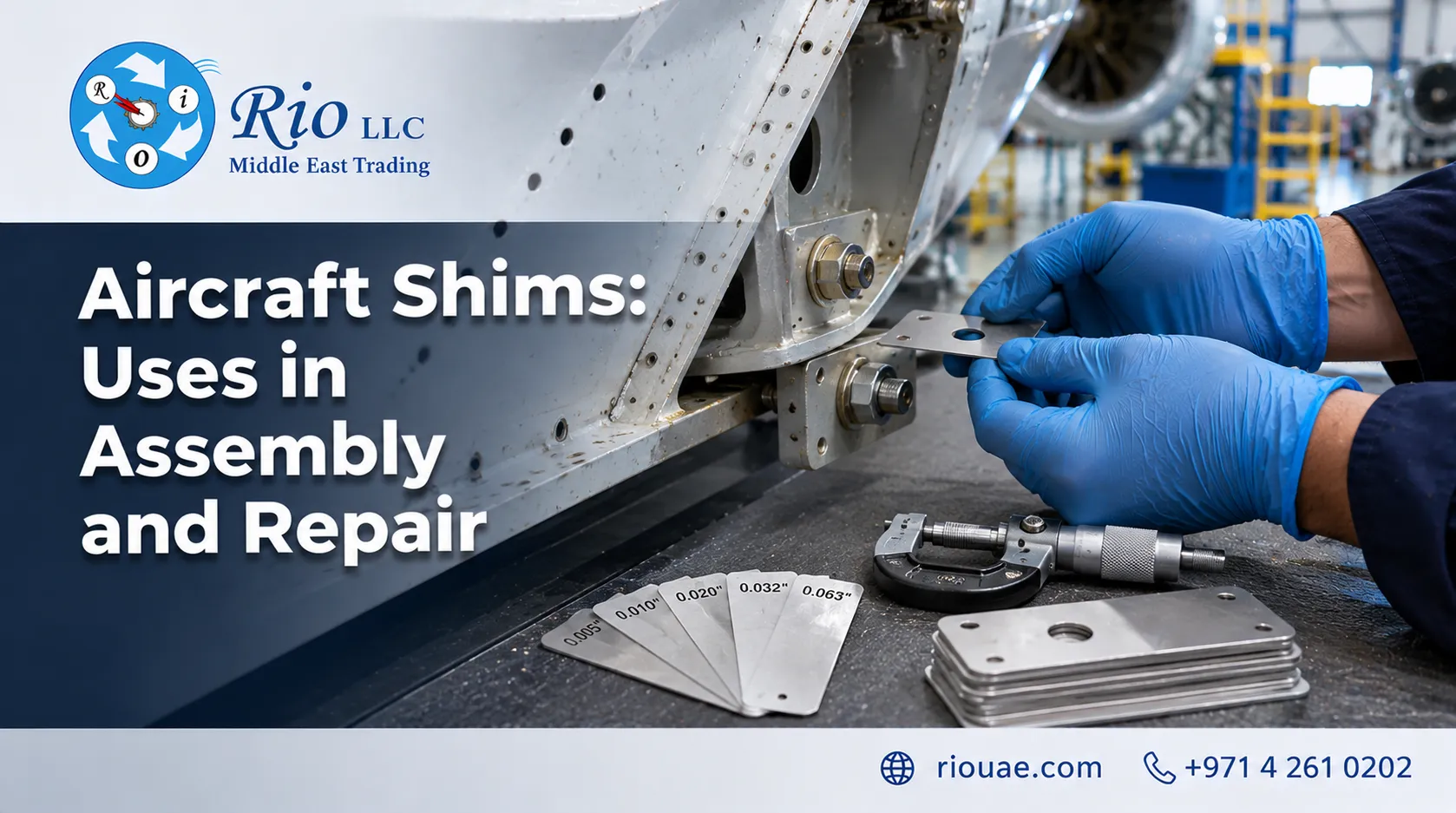
Two aircraft components can be manufactured within their individual tolerances and still need a specified adjustment where they meet. Shims help address these interface requirements when the design or maintenance instructions call for them. Understanding aircraft shims applications starts with their role in the complete assembly, rather than viewing them as spare pieces of material inserted wherever a gap appears.
A shim can provide a defined thickness or fill a specified space between mating surfaces. Its form, material and location depend on the assembly requirement. Aerospace shims may be solid, laminated or moldable, and those formats have different characteristics.
This guide explains how aircraft assembly shims fit into manufacturing and maintenance, what aircraft shim stock means and which details need technical confirmation. It is an informational overview; actual selection, fitting and acceptance must follow the applicable drawing, maintenance data or approved repair instructions.
What Are Aircraft Shims?
Aircraft shims are materials or manufactured items used to establish specified spacing or compensate for dimensional differences between components. Their shape can range from a simple flat profile to a component-specific geometry, while moldable materials can accommodate a specified interface through a controlled forming and curing process.
The important feature is their defined engineering function. A shim may be part of the intended assembly arrangement, with requirements for material, thickness, coverage and installation. Its purpose cannot be established from appearance alone.
RIO’s Shims & Sealants category provides a route to its listed shimming products. The category name groups related materials; it does not mean that shims, sealants and adhesives perform the same function.
Why Assembly Tolerances Create a Need for Shims
Manufactured parts have dimensional tolerances. When several parts come together, their permitted variations can influence the final interface. Shims provide one engineering approach for accommodating that situation where the assembly design allows it.
For example, a specified shim can establish spacing between mating components without requiring every individual part to be machined to the exact final assembled dimension. Manufacturer information describes precision shims as compensators for accumulated tolerances. SPIROL
This does not mean any visible gap should be filled. The gap condition must first be assessed against the relevant requirements. The technical instructions determine whether shimming is appropriate and which solution is permitted.
For aircraft assembly shims, the useful question is not simply how much space is present. It is what the approved assembly arrangement requires at that interface.
Aircraft Shims Applications in Assembly
Establishing specified spacing
Some assemblies require a particular relationship between mating parts. A shim can provide the spacing defined by the design or assembly instructions. The required location and material are part of that arrangement.
Accommodating interface variation
Where permitted, shims can compensate for dimensional variation between components. The acceptable thickness, profile and extent are determined by the applicable technical requirements, rather than by a general rule for all joints.
Supporting equipment alignment
Manufacturer information includes equipment alignment among shimming applications. In an aircraft context, the particular equipment and attachment arrangement need their own instructions. A general alignment example is not authorization to modify an installation.
Filling defined metal or composite assembly gaps
Moldable shim products are available for specified gaps and offsets in metal and composite assemblies. Their suitability depends on the product, substrate and process. They should not be confused with general cosmetic fillers. socomore.com
Together, these aircraft shims applications show why an apparently small item can carry a precise technical requirement.
Where Aerospace Shims May Be Found
Shims are associated with different aircraft and component assemblies. A shim manufacturer may describe applications in control assemblies, hydraulic equipment, auxiliary power units or landing-gear-related work. spirol.com
These examples illustrate the breadth of the product family, not a common fitting procedure. The material and geometry suitable for one location may be inappropriate for another.
For maintenance teams, the component identification and relevant technical data come before a material search. Procurement should work from the required part number, drawing or material specification, rather than assume a shim listed for a similar assembly will be acceptable.
The same distinction applies to aerospace shims used during manufacturing. Customer specifications and qualification requirements establish what belongs in that production process.
Solid, Laminated and Moldable Shims
Different shim formats address different requirements. The following comparison explains their general form; it does not identify which format an aircraft needs.
| Shim format | General description | Key detail to confirm |
| Solid shim | A manufactured piece with a defined material and thickness | Required geometry, material, finish and dimensional tolerances |
| Laminated shim | A bonded layered construction designed for permitted thickness adjustment | Layer arrangement and adjustment requirements |
| Moldable shim | A compound formed at an interface and cured under a specified process | Product identity, permitted gap and processing requirements |
| Pre-catalyzed frozen sheet | A prepared moldable material supplied in sheet form | Exact product, storage conditions and processing limits |
Solid shims
Solid shims can be manufactured to a specified profile and thickness. Their suitability depends on more than the overall dimensions: material and finish can also be part of the requirement.
Laminated shims
Laminated shims contain bonded layers. Certain constructions permit layers to be removed to reach the specified thickness. They are not equivalent to an arbitrary stack of loose sheets, and adjustment must follow the relevant instructions. SPIROL
Moldable shims
Moldable materials can conform to a specified interface before curing. Their mechanical properties, compatibility and processing conditions must suit the application. They are not universal substitutes for solid or laminated shims.
Understanding Aircraft Shim Stock
Aircraft shim stock refers to material supplied for producing or selecting shims to defined requirements. Depending on the product family, stock may take the form of sheet, strip, coil or laminated material. It should be distinguished from a finished, identified shim part.
A stock description alone is not a complete aircraft material specification. The buyer may also need the alloy or material designation, thickness tolerance, condition, finish and supporting documentation required by the task.
Units need attention as well. A thickness expressed in inches should not be mistaken for the same number expressed in millimetres. Use the actual product designation and controlled technical information rather than an informal description.
For aircraft shim stock, the essential distinction is between having material on a shelf and having material accepted for a specific use.
Moldable Shims and Frozen Sheet Materials
Moldable aerospace shims are a separate material category from ordinary metal sheet. SOCOMORE describes its DYNAMOLD range as filled epoxy compounds supplied in forms that include two-part systems and pre-catalyzed frozen sheets.
In frozen sheet products, freezing inhibits the curing process during storage. The material’s subsequent handling and processing are governed by the exact product instructions and the applicable assembly procedure.
The manufacturer’s DMS-4-828 frozen sheet technical data sheet describes this material family and its intended shimming roles. Product information should be reviewed alongside the relevant aircraft or component requirements. socomore.com
RIO lists DMS-4-828 Frozen Sheet 0.020 as a specific product reference. That example illustrates a supplied form, rather than a recommendation for every assembly or repair.
Directions for a two-part kit should not automatically be applied to a pre-catalyzed sheet. Confirm the form and reference before reviewing the processing documents.
Aircraft Shims Applications During Repair
Repair and reassembly can involve a shimming requirement, but the condition must first be assessed through the applicable maintenance or engineering process. A gap after component removal does not, by itself, establish that adding a shim is the correct action.
The relevant data may specify inspection, replacement, dimensional checks or a particular assembly arrangement. Where shimming is included, the material and fitting requirements form part of that instruction.
An existing shim also needs to be understood in context. Its presence does not prove that it may be reused, copied or replaced with a different material. Follow the applicable requirements for its identification and condition.
Aircraft assembly shims should therefore be considered part of the documented installation, rather than treated as a convenient way to hide damage or an unresolved mismatch.

Shims, Sealants and Adhesives Have Different Functions
A shim provides a specified spacing or gap-filling function. A sealant addresses a defined sealing need. An adhesive supports a specified bonding function. Some engineered products may combine functions, but that must be established for the named product and process.
Do not infer interchangeability from similar appearance or the fact that products are supplied as pastes. A cosmetic filler, sealing compound and moldable structural shim can have different requirements.
This distinction helps procurement teams interpret requests accurately. When a task calls for a particular shim material, a quotation for a broadly similar compound needs technical review before acceptance.
Likewise, a product’s ability to adhere to a surface does not independently establish approval as the required adhesive or sealing system.
What Determines the Correct Shim Material?
Selection depends on the application and its technical requirements. Factors to resolve can include:
- The specified part number or material designation.
- Mating materials and surface finishes.
- Required thickness, geometry and permitted tolerances.
- Operating environment and relevant exposure conditions.
- Mechanical properties required by the design.
- Processing, inspection and documentation requirements.
These are review topics, not a formula for designing an aircraft joint. The responsible engineering or maintenance authority establishes the acceptable solution.
For aerospace shims, material selection should account for the complete interface. The same nominal thickness does not make two materials equivalent, and a product described as “aerospace grade” still needs a defined application.
Surface Condition Before Shimming
The surface condition matters to the specified assembly process. Preparation may involve cleaning or other defined work, depending on whether the shim is mechanical, bonded or moldable.
RIO’s surface preparation category contains relevant product families, while its article on aircraft cleaning chemicals explains why compatibility and intended use matter.
The preparation required before painting should not be assumed identical to the preparation required for a shimming application. Follow the task’s actual instructions and product information.
If corrosion, damage or an unexpected surface condition is found, it needs evaluation before the assembly decision proceeds. A shim is not a substitute for resolving that finding.
Inspection and Records After Assembly
The applicable process determines which checks are needed before accepting the work. Depending on the task, these can address identification, fit, dimensions, processing records or other specified criteria.
For moldable systems, a general statement that the material has hardened does not replace the required processing and acceptance checks. For solid or laminated formats, visual appearance alone does not establish that the dimensional and material requirements have been met.
Where an inspection method is specified, the relevant personnel and capability need to be available. RIO’s non-destructive testing category provides material-family context; it does not mean NDT is required for every shim installation.
Records connect the material and completed task with the assembly’s maintenance or production history.
Planning an Aircraft Shim Stock Enquiry
A clear enquiry distinguishes raw stock, a finished shim and a moldable material. Include the full reference or specification, required form, quantity and dimensional information available from the task.
For a finished item, identify the drawing or part number and revision where required. For aircraft shim stock, state the material designation, thickness and supply form. For a moldable product, identify the exact formulation and package or sheet format.
Also request the documents needed by the organization and confirm any relevant storage or delivery conditions. Frozen products can require different arrangements from ordinary metal stock.
If the technical requirement is incomplete, flag it for confirmation rather than selecting a material by matching the gap dimension alone.
Common Misunderstandings About Aircraft Assembly Shims
Every gap needs a shim. A gap must be assessed against the applicable requirements before deciding what action is permitted.
Thickness is the only important feature. Material, shape, finish and process requirements can be equally relevant.
More layers provide a better fit. The allowed construction and adjustment come from the technical instructions, not a general stacking rule.
Moldable shims are ordinary fillers. Their intended function and properties are product-specific.
An old shim can always be reused. Reuse depends on the applicable maintenance requirements and the item’s condition.
Understanding these distinctions keeps aircraft shims applications tied to engineering intent rather than workshop assumptions.
Frequently Asked Questions
What are common aircraft shims applications?
Examples include specified spacing, tolerance compensation, interface gap filling and alignment in assembly or approved repair work. The actual location and material depend on the aircraft or component instructions.
Are aerospace shims always metallic?
No. The wider product family includes metallic, laminated and moldable materials. Select the material specified for the task rather than assuming one type is suitable everywhere.
What is the difference between aircraft shim stock and a finished shim?
Stock is supplied material from which an identified shim may be produced or selected. A finished shim has the required part geometry and identification. Applicable controls still govern its use.
Can aircraft assembly shims replace structural repair?
They should not be used to bypass damage assessment or repair requirements. Shimming is appropriate only where the applicable technical instructions permit it.
What is special about frozen moldable shim sheets?
They are prepared material whose curing is inhibited during frozen storage. Handling and use depend on the named product and process, which can differ from two-part kit instructions.
Connect the Shim With the Complete Assembly Requirement
Aircraft shims applications concern the relationship between mating components, the specified material and the intended assembly condition. Solid, laminated and moldable formats provide different solutions, and selection depends on the technical data governing the work.
For listed shimming products, RIO Middle East can review the required reference, form, quantity, destination and documentation needs. Establishing those details helps connect a product enquiry with the actual assembly or maintenance requirement.