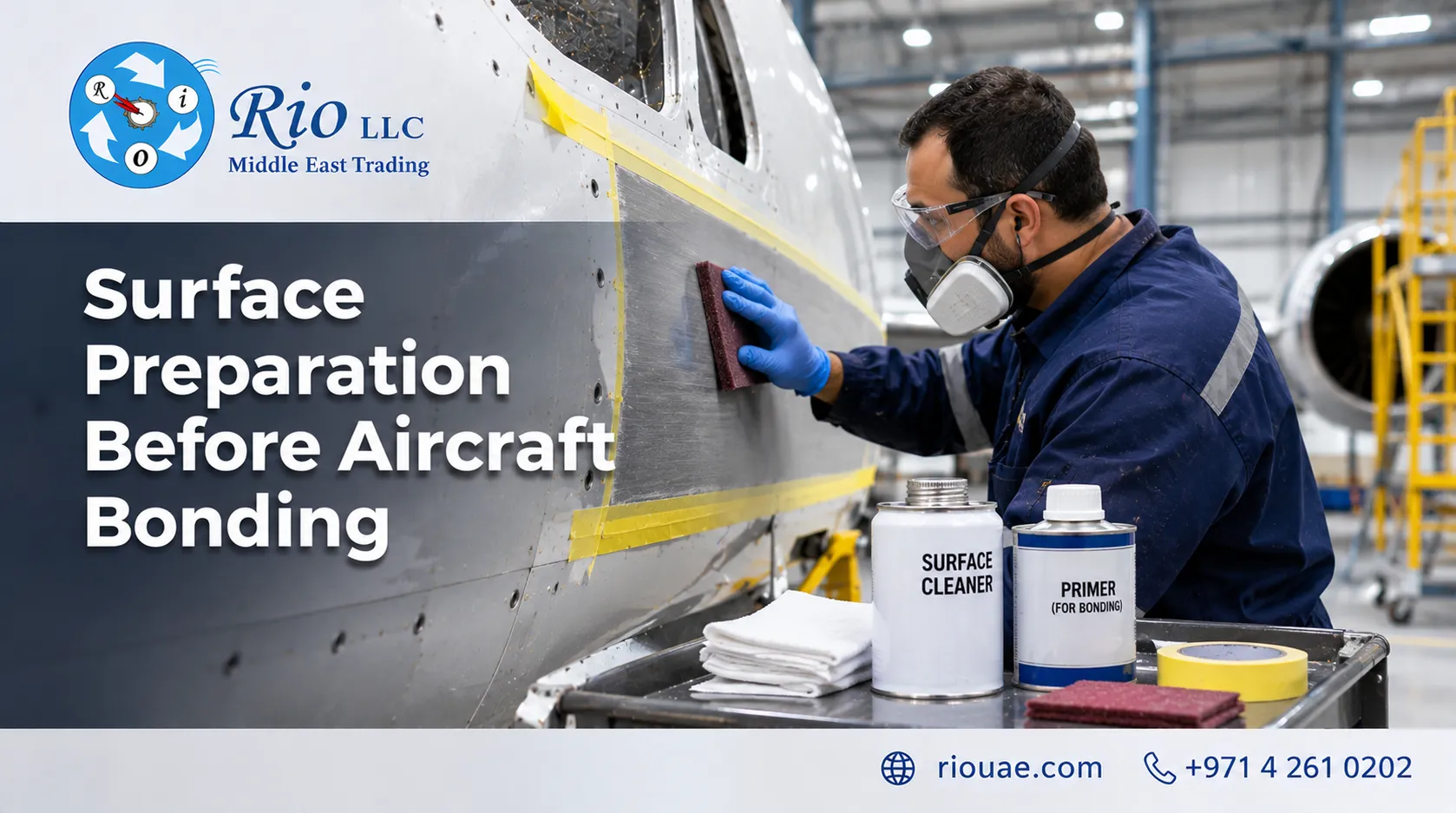
Surface Preparation Before Aircraft Bonding

An adhesive joint can look complete while hiding a problem at its most important location: the interface between the adhesive and the aircraft component. A thin film of contamination, an unsuitable surface layer, or handling after cleaning can affect that interface without producing an obvious visual warning.
Aircraft bonding surface preparation is the controlled work that establishes the surface condition required by a specified adhesive bonding process. Depending on the application, it can include cleaning, mechanical preparation, chemical treatment, and protection before assembly.
This guide explains what makes a surface ready for bonding, how material differences influence preparation, and where an aircraft adhesion promoter fits. The focus is adhesive bonding in aircraft assembly and repair; electrical bonding is a separate subject. Actual work requires the applicable aircraft, component, and approved process instructions.
Why the Bonding Surface Deserves Special Attention
An adhesive joins surfaces, so its performance depends partly on what it actually contacts. That contact may be with the intended substrate, a specified primer, or an unwanted film left by an earlier operation.
Two useful terms explain the distinction. Adhesion describes attachment at the interface between materials. Cohesion describes strength within a material, including the adhesive itself. Selecting a capable adhesive does not automatically establish the required interface.
Aircraft bonding surface preparation therefore addresses a question that adhesive selection alone cannot answer: is the exposed surface in the condition required for this particular joint?
Think of preparation as establishing a known starting condition. Without that starting condition, a correctly identified adhesive and a completed cure record leave an important part of the process uncertain.
Bonding Preparation and Paint Preparation Have Different Endpoints
Painting and adhesive bonding can involve similar product families, including cleaners and pretreatments. Their final interfaces, however, serve different purposes. A paint preparation specification qualifies a surface for a coating system; a bonding specification qualifies it for a particular bonded assembly.
A surface accepted for painting is therefore not automatically accepted for structural adhesive bonding. Likewise, a product described as a paint adhesion promoter should not be substituted into a bonding process without supporting technical authority.
RIO’s article on surface preparation before aircraft painting covers the coating application. Here, the central concern is the substrate–adhesive interface and its condition immediately before joint assembly.
Keeping that endpoint clear helps teams distinguish aerospace bonding preparation from general cleaning or refinishing work.
What Can Remain on a Surface That Looks Clean?
Visual cleanliness is useful, but it cannot reveal every substance that might interfere with bonding. Potential contaminants include handling oils, machining residues, silicone, release agents, cleaning residues, and material transferred from unsuitable wipes or tools.
Composite bonding research also identifies peel-ply residue and release-film contamination as factors worth investigating. Their effects depend on the materials and bonding system; the same appearance does not establish the same surface chemistry.
This makes the component’s recent history relevant. Was it machined, temporarily protected, transported, or exposed to nearby spraying? Did someone handle it after preparation? Those questions help identify possible contamination routes.
The practical lesson is to evaluate how the surface reached its current condition. A final wipe cannot be assumed to resolve an unknown contamination event.
How Wetting Relates to Adhesion
Wetting describes how readily a liquid spreads across and maintains contact with a solid surface. An adhesive needs appropriate contact with the intended bonding surface, and contamination can interfere with that contact.
Surface energy helps explain why some material–adhesive combinations wet more readily than others. Preparation may modify the surface chemistry or remove a layer that obstructs wetting. Mechanical texture can also influence contact, but a rough appearance alone does not demonstrate readiness.
Importantly, good wetting is not a complete measurement of bond strength or long-term durability. It is one aspect of the interface.
Aircraft bonding surface preparation should therefore be assessed against defined acceptance criteria, rather than an assumption that a visibly rough surface or spreading liquid guarantees a dependable joint.
Why the Substrate Changes the Preparation Strategy
Metallic surfaces
For metals, preparation may need to address oils, machining contamination, corrosion products, and the condition of the oxide layer. The required treatment depends on the alloy and qualified bonding system.
Aluminium, titanium, and stainless steel should not be grouped under one universal preparation method. Their surface behaviour and permitted treatments can differ. An existing coating or primer also changes which material the adhesive will actually contact.
The useful starting question is therefore specific: what surface is present at the bond location, and what condition does the process require there?
Composite surfaces
For cured composites, preparation needs to consider the resin system, reinforcement, manufacturing history, and condition of the exposed surface. Removing contamination must be balanced with preserving the laminate.
Aggressive abrasion can damage material that the repair or assembly depends on. Exposed fibres should not be treated as a universal sign of successful preparation.
Where peel ply is used, its material, processing history, and removal requirements belong to the qualified bonding process. Removing any fabric layer does not automatically produce an acceptable bonding surface.
These differences explain why aerospace bonding preparation starts with material identification rather than a favourite cleaner or abrasive.
Cleaning, Abrasion, and Treatment Perform Different Jobs
It helps to separate three functions that are sometimes described collectively as preparation.
| Preparation function | Main purpose | Question to resolve |
| Cleaning | Remove the contamination targeted by the process | Is the cleaner compatible and permitted for this surface? |
| Mechanical preparation | Establish the specified surface condition through a controlled physical method | Can the required condition be achieved without damaging the substrate? |
| Chemical treatment | Modify or condition the interface for the bonding system | Is the treatment qualified with the substrate and adhesive? |
These functions may appear together, but one should not be assumed to replace another. Their sequence also matters: a later operation can change the condition established earlier.
RIO’s manual surface cleaning category helps identify cleaning products. Selection for a bond location still requires the exact product documentation and process reference.
For broader context on compatibility, the guide to aircraft cleaning chemicals explains why a general cleaning description is insufficient for every aircraft application.
What Does an Aircraft Adhesion Promoter Do?
An aircraft adhesion promoter is a surface-conditioning product used where the specified system calls for it. Its role is to help establish a compatible interface for a subsequent material; it is not the structural adhesive itself.
The term covers products with different chemistries and intended applications. A promoter used before painting may have different requirements from a pre-bond treatment. Similar names, colours, or packaging do not establish interchangeability.
An aircraft adhesion promoter also cannot be assumed to compensate for unresolved contamination or an incorrect substrate condition. Its effectiveness belongs to the complete preparation and bonding system.
RIO’s adhesion promoter category provides a useful way to browse this product family. The important technical check is whether the exact product reference is specified for the intended substrate, adhesive, and application.
A pre-bond product example
SOCOGEL B0102 is listed by RIO as a two-component pre-bond surface preparation sol-gel. It illustrates the distinction between a dedicated pretreatment and a general-purpose cleaner.
Its use still depends on the applicable process, required preceding preparation, and current technical documentation. A catalogue listing does not independently approve a product for every aircraft joint. SOCOMORE Solutions

Understanding the Preparation Sequence
Surface preparation before aircraft bonding is best understood as a sequence with defined entry and exit conditions. The following stages explain the logic; they are not an executable repair procedure.
- Identify the joint and materials. Establish the substrate, existing surface condition, adhesive system, and governing work instructions.
- Address the specified contamination. Use the required cleaning method and controlled consumables.
- Create the required surface condition. Carry out only the mechanical or chemical preparation identified by the process.
- Complete any specified pretreatment. Apply the required aircraft adhesion promoter or bonding primer where applicable.
- Verify readiness and protect the interface. Complete the required checks and maintain the surface condition until assembly.
The value of this sequence is the connection between stages. If a part returns from another operation, the team needs to know whether its previous preparation remains acceptable.
The FAA’s AC 43-214A on composite and bonded aircraft structure provides broader guidance on bonded repairs and associated process controls. It describes an acceptable means of compliance and does not replace the instructions applicable to a particular repair. faa.gov
Protecting the Surface Between Preparation and Assembly
Aircraft bonding surface preparation does not end when the final cleaning or treatment operation is recorded. The prepared surface must retain its required condition until the next permitted step.
Handling, contaminated gloves, unsuitable temporary coverings, airborne particles, and nearby spray operations can introduce new material onto the interface. A protected work area and clearly identified parts help reduce those opportunities.
There is no universal period for which every prepared aircraft surface remains ready to bond. Permitted hold times, storage conditions, and any required reactivation or repeat preparation depend on the specified system.
A useful handover records when preparation finished, what protection was applied, and whether an interruption occurred. “Prepared yesterday” conveys less useful information than a traceable record tied to the applicable time limits.
Moisture and Workshop Conditions Matter
Surface preparation before aircraft bonding takes place within a physical environment. Ambient temperature, humidity, component temperature, and moisture history can affect the conditions at the interface.
A component moved between storage and the work area may need attention to condensation. For composite repairs, moisture management may also form part of the defined repair process. These concerns should be resolved through the applicable instructions rather than an improvised drying method.
The preparation plan should identify any environmental limits and how the organization verifies them. It should also make clear when those conditions matter during transfer, treatment, and assembly.
This keeps environmental control connected to the actual surface instead of treating a single room reading as a complete record of the component’s condition.
What Can Inspection Confirm Before Bonding?
Inspection needs a defined question. Visual examination can identify obvious residue, damage, incomplete coverage, or other visible conditions, but it cannot independently characterize every potential contaminant.
Some qualified processes use wettability measurements or other surface checks. Their methods and acceptance limits must be suitable for the material and process. Introducing an unapproved test liquid onto a bonding surface can itself create a new concern.
Similarly, a satisfactory surface check should not be presented as a direct measurement of the finished joint’s strength. Surface acceptance, cure verification, and bond inspection provide different kinds of evidence.
In aerospace bonding preparation, the aim is to combine the required checks with traceable process control. A single reassuring observation should not erase a recorded deviation elsewhere in the sequence.
Common Assumptions That Can Undermine Preparation
Several mistakes begin with a plausible shortcut:
- “It is approved for aircraft, so it is suitable here.” Aircraft use alone does not establish compatibility with this bonding process.
- “More abrasion will improve adhesion.” Additional material removal may exceed the specified surface condition or damage the component.
- “The promoter will solve a cleaning problem.” A pretreatment is not permission to leave contamination unresolved.
- “The peel ply has been removed, so preparation is complete.” Readiness depends on the qualified material and process requirements.
- “The surface still looks clean after the interruption.” Appearance does not establish continued compliance with hold-time or handling requirements.
Recognizing these assumptions helps teams ask a more useful question: what evidence demonstrates that this surface still meets the next stage’s requirements?
A Practical Handover Checklist
Before releasing a prepared component for adhesive application, the work record should make the relevant status understandable to the receiving team. Useful items include:
- Component identity and the defined bonding area.
- Preparation instruction and revision used.
- Cleaning and treatment product references, including required batch information.
- Completion times and applicable remaining hold period.
- Required inspection results and environmental records.
- Protective measures, interruptions, and unresolved deviations.
This is a planning aid, not a replacement for the organization’s approved records. Its purpose is to prevent important preparation information from disappearing between workstations or shifts.
The same logic applies when preparation and bonding occur in different areas: the receiving team needs evidence of readiness, not simply confirmation that an earlier task was marked complete.
Frequently Asked Questions
Is cleaning enough before aircraft adhesive bonding?
Only when the applicable process defines cleaning as sufficient. Other joints may require mechanical preparation, chemical treatment, a bonding primer, or additional checks. The surface and adhesive system determine the required combination.
Is an aircraft adhesion promoter the same as an adhesive?
No. A promoter conditions the interface where specified, while the adhesive forms the joint. A bonding primer may have another defined role. Product names should be checked against their technical function and system requirements.
Can the same method prepare metal and composite parts?
Not automatically. The materials respond differently to cleaning, abrasion, and treatment. Each side of a mixed-material joint needs the preparation specified for that surface within the qualified assembly.
Can a surface be prepared again after a delay?
The permitted response depends on the process and the reason for the delay. Repeat cleaning, reactivation, or full preparation should follow an authorized instruction; additional treatment should not be added by assumption.
Establish the Interface Before Making the Joint
Effective aircraft bonding surface preparation establishes a known surface condition, preserves it through handling, and provides evidence that the joint is ready for adhesive application. That requires attention to both material compatibility and the continuity of the process.
For product research, explore RIO Middle East’s surface preparation range. Match any candidate material to the specified bonding system and current technical documents before selection. The goal is a controlled interface that supports the intended assembly or repair.